
How to Invest in Stocks in the Philippines: Beginner Guide
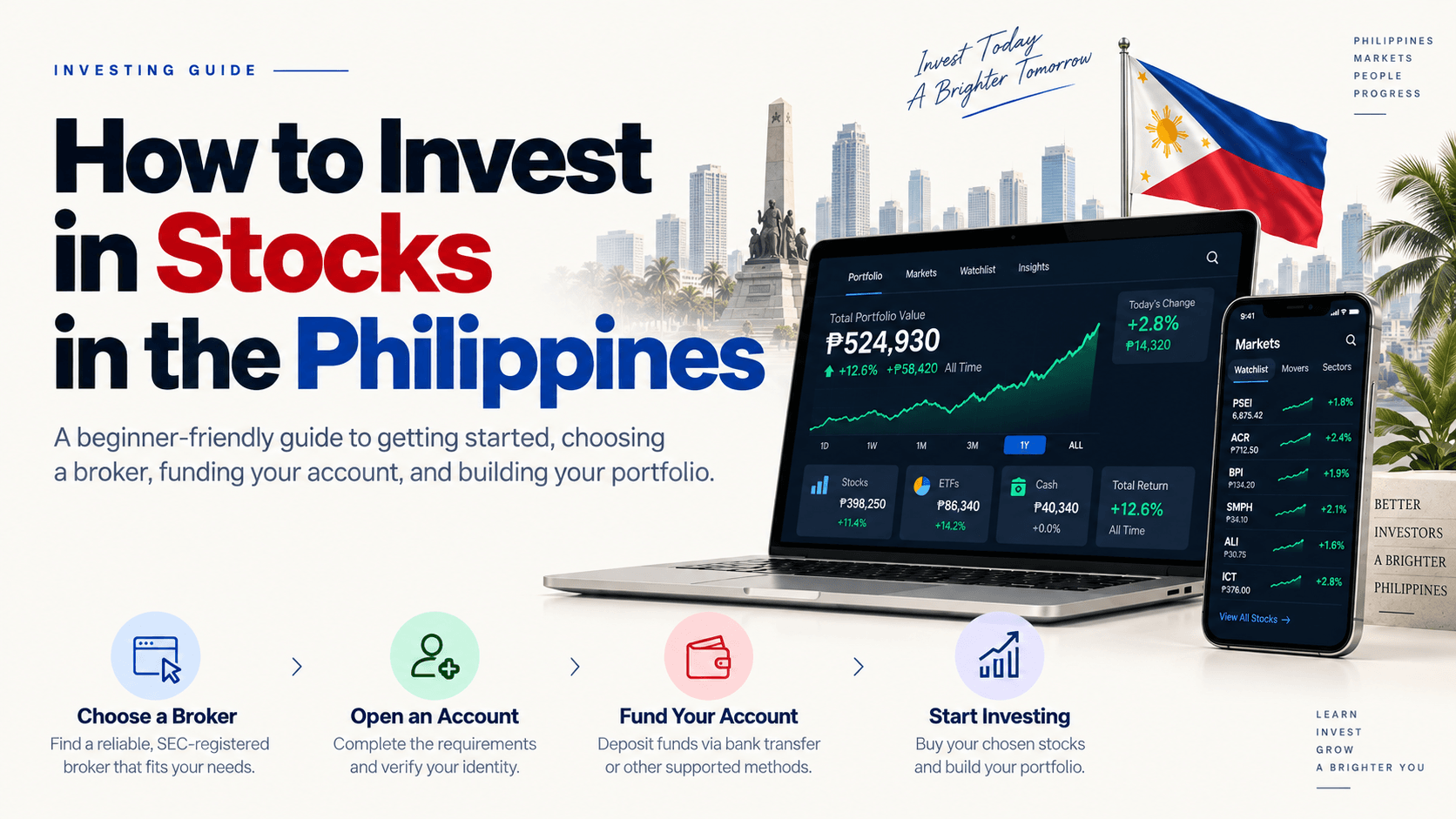
If you’re wondering how to invest in stocks in the Philippines, the basic process is straightforward: choose a PSE-accredited stockbroker, open and fund an account, research a company or fund you understand, and place a buy order through your broker. The same process applies whether you’re searching how to invest in the Philippine stock market, how to buy PSE shares, or how to start stock investing as a beginner.
The difficult part is not clicking the “Buy” button. It is knowing how much money you actually need, which broker fits you, how board lots work, what fees and taxes you will pay, and how to avoid buying a stock just because someone online said it would go up. This guide covers those details using current information from the Philippine Stock Exchange and broker first-party sources. Because broker minimums, fees, and market rules can change, the official source links throughout this guide should always be your final check.
How do you start investing in the Philippine stock market?
1. Build an emergency fund and decide how much money you can invest for the long term.
2. Choose a PSE-accredited broker and complete its KYC/account-opening requirements.
3. Fund the account. Your broker’s account minimum is different from the minimum amount needed to buy a specific stock.
4. Research the company, REIT, or ETF before buying. Understand the business, earnings, debt, valuation, dividends, and risks.
5. Enter a buy order that follows the current PSE board-lot and price rules, then monitor your investment based on your original reason for buying—not daily noise.
Important board-lot note: The PSE has proposed a “One Lot One Share” structure for its new trading engine. However, the Exchange’s official investing page currently still publishes the existing price-based board-lot table. This guide follows the live PSE investing page. If the Exchange formally changes the rule, use the latest PSE board-lot schedule rather than an older article or screenshot.
What Is the Philippine Stock Market?
The Philippine Stock Exchange (PSE) is the marketplace where shares of publicly listed Philippine companies are bought and sold. When you buy common shares, you are buying a small ownership interest in that company. Your investment can gain or lose value as the market price changes.
Investors generally make money in two ways:
The share price rises
If you buy a stock at ₱50 and later sell it at ₱70, the difference—after applicable fees and taxes—is your capital gain. A stock can also fall below your purchase price, so gains are never guaranteed.
The company pays dividends
Some profitable companies distribute part of their earnings to shareholders. The PSE currently lists a 10% withholding tax on dividends received by Filipino citizens or resident aliens.
The PSE also lists REITs and ETFs. REITs give investors exposure to income-generating real estate through a listed company structure, while ETFs can provide exposure to a basket of securities through one exchange-traded investment. The PSE describes ETFs as a way to obtain diversification in a single trade.
Official references: PSE — Investing at PSE · PSE — REITs · PSE — ETFs.
Before You Invest: Make Sure Stocks Fit Your Money
Stocks are not a replacement for emergency savings. Their prices can fall at exactly the time you need cash. Before opening a trading account, decide whether the money can remain invested through market declines without affecting rent, food, debt payments, tuition, or other near-term obligations.
How Much Money Do You Need to Start Investing in Stocks in the Philippines?
There is no single PSE-wide peso minimum that applies to every beginner. You need to separate two different numbers:
Broker account minimum
This is the amount a broker may require to activate or fund your trading account. It varies by broker and can change.
Minimum stock purchase
This depends on the stock’s market price and its current PSE board lot. A broker can let you open with ₱1,000 even if the stock you want requires more than ₱1,000 to buy a regular board lot.
Examples of published broker minimums
| Broker | Published starting requirement | Useful for | Important note |
|---|---|---|---|
| GStocks PH (AB Capital via GCash) | No minimum amount required to open a GStocks PH trading account | Beginners who want to access PSE stocks from the GCash app | AB Capital’s current GStocks PH FAQ says Filipino applicants must be at least 18, fully verified on GCash, and provide required KYC information including SSS number and TIN. |
| DragonFi | As low as ₱1,000 | Beginners who want a low account-opening threshold and modern app/web tools | DragonFi’s current pricing page publishes a 0.25% stock commission; standard PSE/SCCP fees and current taxes also apply. |
| BDO Securities | No minimum account balance stated on its retail education page | Existing BDO customers who want bank-to-broker convenience | Its retail guide says you need a BDO savings account and online banking for the streamlined online account route. |
| COL Financial | ₱25,000 to activate a new account | Investors who want COL research and education and are comfortable with the higher activation amount | COL’s current main FAQ says that starting August 2025, ₱25,000 activates a Wealth Builder account. Some older COL pages still display legacy Starter/Plus/Premium minimums, so use the current main FAQ when applying. |
Broker sources: AB Capital — GStocks PH FAQ · DragonFi Pricing · BDO Securities — Minimum Investment · COL Financial — Current Main FAQ. Always re-check before opening an account because minimums can change.
How to Choose a Stock Broker in the Philippines
You cannot directly send an order to the PSE as a retail investor. The PSE says stock-market transactions are executed through accredited Trading Participants, commonly called brokers. The Exchange publishes a directory where you can verify active participants.
Consider GStocks PH
AB Capital’s current FAQ says there is no minimum amount required to open a GStocks PH trading account. It is accessed inside GCash and is designed for PSE-listed securities.
Consider DragonFi
Its current pricing page says an account can be opened for as low as ₱1,000 and includes web/mobile trading plus research tools.
Consider BDO Securities
Its retail guide says there is no minimum account balance, making it convenient for eligible existing BDO customers.
Do not choose a broker only because an influencer uses it. Compare:
Check the official PSE Trading Participant directory before opening an account.
How to Invest in the Philippine Stock Exchange: Step by Step
Choose a PSE-accredited broker
Compare the broker’s minimum investment, fees, platform, funding methods, research tools, and customer support. Verify the broker in the PSE directory.
Open and verify your account
The broker will conduct Know Your Customer (KYC) checks. Requirements vary, but expect identity information, government-issued identification, contact details, tax information, and bank or settlement details.
Fund the account
Online brokerage accounts are generally pre-funded before you submit a buy order. Deposit only money that fits your investment plan, not your emergency budget.
Research what you want to buy
Read company disclosures and financial statements. Know how the business makes money, whether profits are growing, how much debt it carries, what can hurt the business, and whether the current price makes sense relative to the company’s fundamentals.
Check the board lot and current price
The PSE’s current board-lot table determines the regular-market minimum quantity based on a stock’s price. Your broker’s order ticket usually displays the allowed quantity increments.
Place your buy order
A limit order lets you specify the highest price you are willing to pay. Your order executes only if the market can match it at that price or better. Do not confuse placing an order with an immediate guarantee of execution.
Keep the confirmation and monitor the investment
The PSE settlement cycle is currently T+2. Shares generally appear in an online investor’s portfolio immediately after execution, while clearing and settlement complete two clearing days after the trade date.
Official process: PSE — Investing Procedure and Trading Cycle.
PSE Board Lots: Why the Minimum Number of Shares Still Matters
A board lot is the regular-market minimum trading quantity for a stock at a given price. Under the PSE’s currently published table, the lot size changes as the stock price changes.
| Stock price | Current regular-market lot size | Example minimum gross purchase |
|---|---|---|
| ₱5.00–₱9.99 | 100 shares | At ₱8/share: ₱800 before fees |
| ₱10.00–₱19.98 | 100 shares | At ₱15/share: ₱1,500 before fees |
| ₱20.00–₱49.95 | 100 shares | At ₱30/share: ₱3,000 before fees |
| ₱50.00–₱99.95 | 10 shares | At ₱80/share: ₱800 before fees |
| ₱100.00–₱199.90 | 10 shares | At ₱120/share: ₱1,200 before fees |
| ₱200.00–₱999.50 | 10 shares | At ₱500/share: ₱5,000 before fees |
| ₱1,000.00–₱1,999.00 | 5 shares | At ₱1,200/share: ₱6,000 before fees |
The table above is a simplified excerpt. Very low-priced and very high-priced securities have additional bands, so check the full PSE table or your broker before submitting an order.
Sources: Current PSE Board Lot Table · PSE Consultation Paper on One Lot One Share.
Example: Buying Your First Philippine Stock With a Small Budget
Suppose a hypothetical company is trading at ₱100 per share. Under the PSE’s current board-lot table, a stock in the ₱100–₱199.90 range has a regular-market lot size of 10 shares.
Hypothetical 10-share purchase at ₱100
This is an illustration using the same fee framework published by the PSE and a hypothetical broker commission of 0.25%. Your broker’s commission schedule can differ, and the PSE says a broker may set its own commission schedule subject to the applicable maximum.
Stock Market Fees and Taxes in the Philippines
Every buy or sell order has costs. Beginners often focus only on the stock price, but fees matter—especially for frequent trading.
| Fee or tax | Current published rule | When charged |
|---|---|---|
| Broker commission | Broker-specific; PSE says maximum allowable rate is 1.5% plus 12% VAT and there is no prescribed minimum commission | Buy and sell |
| SRC fee | 0.005% of transaction value under Section 35 of the Securities Regulation Code, as shown in the PSE’s current transaction examples | Buy and sell |
| PSE transaction fee | 0.005% of transaction value, exclusive of 12% VAT | Buy and sell |
| SCCP clearing fee | 0.01% of transaction value | Buy and sell |
| Stock transaction tax | 0.1% of transaction value, effective July 1, 2025 under the Capital Markets Efficiency Promotion Act (down from 0.6%) | Seller only |
| Dividend withholding tax | 10% for a Filipino citizen or resident alien under the PSE’s current schedule | When taxable dividends are paid |
Watch out for outdated fee pages. The stock transaction tax dropped to 0.1% of the sale value on July 1, 2025 under Republic Act No. 12214 (CMEPA), down from 0.6%. Some broker help pages published or updated after that date still display the old 0.6% figure. For the tax rate, this guide follows the current PSE schedule, which states that the 0.1% rate has applied since July 1, 2025.
Official fee schedule: PSE — Transaction Fees & Taxes · PSE Circular — STT Decrease Effective July 1, 2025.
Philippine Stock Exchange Trading Hours
The PSE currently says trading days are Monday through Friday from 9:00 a.m. to 3:15 p.m., excluding exchange holidays.
| Time | Phase |
|---|---|
| 9:00 a.m. | Pre-open |
| 9:30 a.m. | Market open |
| 12:00 noon | Market recess |
| 1:00 p.m. | Market resumes |
| Afternoon closing phases | Pre-close / run-off / trading-at-last according to the current PSE schedule |
| 3:15 p.m. | End of trading day |
Do not confuse trading hours with settlement. An executed trade is reflected by your online broker quickly, but the PSE’s clearing and settlement cycle is currently T+2.
Stocks, REITs, or ETFs: What Should a Beginner Understand First?
There is no security that is automatically “best for beginners.” The better question is what type of exposure matches your goal and whether you understand the investment.
Direct company ownership
You choose specific companies. This can offer strong upside if the business performs well, but it also creates company-specific risk and requires more research.
Income-producing real estate exposure
PSE-listed REITs own income-generating real estate and distribute returns primarily through dividends. They still carry market, property, interest-rate, sponsor, and business risks.
A basket in one trade
An ETF can provide exposure to multiple securities through one exchange-traded vehicle, reducing the need to select every constituent individually.
Diversification is not the same as “many tickers”
Owning several companies from the same sector can still leave your portfolio concentrated. Look through to the underlying business and sector exposure.
How to Research a Philippine Stock Before Buying
Do not start with “What stock will go up?” Start with “What am I buying, and why should this business be worth more or continue producing cash for shareholders over time?”
Useful starting points include PSE EDGE for company disclosures and your broker’s research tools.
Investing vs. Trading: Know Which One You Are Doing
A long-term investor typically buys because they expect a business or diversified vehicle to create value over years. A trader is more focused on price movement over shorter periods. Both involve risk, but they require different decision rules.
The biggest problem is when someone says they are a long-term investor only after a short-term trade goes against them. Decide your strategy before entering the position: why you are buying, what would prove your thesis wrong, how much of your portfolio you are willing to allocate, and when you will review the investment.
Philippine Stocks vs. U.S. Stocks
Philippine stocks can give you direct exposure to local banks, property companies, utilities, consumer businesses, conglomerates, REITs, and other parts of the domestic economy. They are also peso-denominated and can be easier to fund through a local bank or broker.
U.S. markets, on the other hand, offer a much larger universe of companies, sectors, and ETFs, plus U.S.-dollar exposure. The trade-off is additional cross-border regulatory, currency, tax, custody, and funding considerations.
You do not necessarily have to choose one market forever. Some investors use Philippine securities for local exposure and international securities for broader diversification. If you are considering the U.S. market too, read my separate guide on how to buy U.S. stocks from the Philippines.
Common Beginner Mistakes to Avoid
Frequently Asked Questions
These FAQs are based on recurring questions found in current Philippine stock-investing search results, broker FAQs, and recent beginner discussions from Filipino investors. I kept only questions that people are actively searching or asking and removed weaker, invented-for-schema questions.
How do I start investing in the stock market in the Philippines?
Start by choosing a PSE-accredited broker, completing its KYC requirements, funding the account, researching the security you want to buy, checking the current board lot, and placing your order through the broker. The PSE’s official Trading Participant directory is the best place to verify that a local broker is accredited.
How much money do I need to start investing in stocks in the Philippines?
There is no single PSE-wide minimum. Your starting amount depends on both the broker and the stock you want to buy. GStocks PH currently states no minimum amount is required to open its trading account, DragonFi advertises account opening from ₱1,000, BDO Securities states no minimum account balance for its retail online route, and COL Financial’s current main FAQ requires ₱25,000 to activate a new account.
Can I start investing in Philippine stocks with ₱1,000?
Yes, it can be possible. DragonFi currently advertises account opening from ₱1,000, while GStocks PH states there is no minimum amount required to open its account. Whether ₱1,000 is enough to buy a particular stock depends on that stock’s price, current PSE board lot, and transaction fees.
What is the best stock broker in the Philippines for beginners?
There is no universal best broker. GStocks PH can be convenient for GCash users and currently states no opening minimum; DragonFi has a low published ₱1,000 threshold and modern trading tools; BDO Securities can be convenient for eligible BDO customers; and COL Financial offers established research tools but currently requires ₱25,000 to activate a new account. Verify PSE accreditation and compare fees, funding, research, and platform usability before choosing.
Can I buy Philippine stocks using GCash?
Yes. GStocks PH is AB Capital Securities’ online retail stock-trading service accessible through the GCash app. Its current FAQ says eligible users can buy, sell, and manage PSE-listed securities through GStocks PH, and it currently states there is no minimum amount required to open the trading account.
Can I buy just one share on the Philippine Stock Exchange?
For regular-market trades, the PSE’s currently published board-lot table still sets minimum quantities based on the stock price. The Exchange proposed a One Lot One Share structure for its new trading engine, but the current public investing page still shows the existing board-lot rules. Odd-lot facilities may allow quantities below a regular board lot depending on the broker and order type.
What fees do I pay when buying or selling Philippine stocks?
Typical costs include your broker’s commission plus VAT, the SRC fee, the PSE transaction fee, and the SCCP clearing fee. Sellers also pay the current 0.1% stock transaction tax. The PSE states there is no prescribed minimum broker commission, so the exact commission can vary by broker.
What time does the Philippine Stock Exchange open?
The PSE’s current whole-day schedule starts with pre-open at 9:00 a.m. and regular market trading at 9:30 a.m. There is a market recess at 12:00 noon, trading resumes at 1:00 p.m., and the closing phases run through the 3:15 p.m. market close, excluding exchange holidays.
How do I choose which Philippine stocks to buy?
Start with the business rather than the ticker. Look at how the company earns money, revenue and earnings trends, debt, cash flow, competitive position, valuation, dividend sustainability, liquidity, and risks. Use PSE EDGE and company disclosures as primary sources instead of buying solely because of a social-media tip.
Should a beginner invest for the long term or start trading?
They are different activities. Long-term investing focuses on owning businesses or diversified vehicles over years, while trading focuses more on shorter-term price movement and requires a defined strategy, risk controls, time, and discipline. Beginners should understand the difference before putting money at risk rather than turning a losing short-term trade into an accidental long-term investment.

Ulysses Lacson writes about investing, trading platforms, market risk, and financial tools for Filipino readers. His guides focus on practical execution, current platform rules, and first-party sources rather than treating investing as a shortcut to quick profits.
